



Visit PBS NewsHour Extra for more education resources designed to help teachers and students identify the who, what, where and why-it-matters of the major national and international news stories.
Essential question
How might presidential debates affect how the electorate decides to vote?
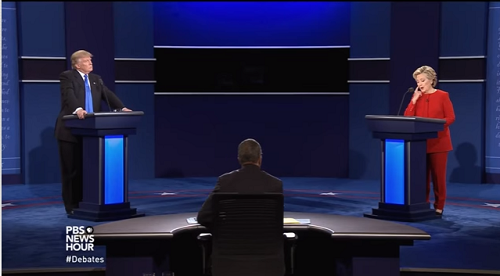
Hillary Clinton and Donald Trump faced off Monday night in the first of three presidential debates leading up to this year’s election on Nov. 8.
Over the course of the debate, moderator and NBC anchor Lester Holt asked the candidates to share their plans for addressing a number of issues facing the nation, including continuing conflicts between police and African American communities.
“Unfortunately, race still determines too much,” Clinton began. “Often it determines where people live, determines what kind of education in their public schools they can get and yes, it determines how they’re treated in the criminal justice system.”
Clinton pointed to her campaign’s criminal justice reform platform and said she would focus on two key areas — working to restore trust and respect between the police and communities of color and tackling the “plague of gun violence” in inner city neighborhoods, which is a leading cause of death for young African American males.
“Everyone should be respected by the law, and everyone should respect the law,” Clinton said. “Right now that’s not the case in a lot of our neighborhoods.”
Trump highlighted his endorsement from the Fraternal Order of Police and a number of other police groups around the country and said his plan would restore law and order in some of the nation’s most violent neighborhoods.
“We have gangs roaming the streets, and in many cases they’re illegally here — they’re illegal immigrants,” Trump said. “We have to bring back law and order.”
Trump referenced Chicago’s extremely high rate of gun violence and gun deaths and suggested employing a program similar to New York City’s controversial stop-and-frisk, which a judge ruled unconstitutional in 2013.
“Right now our police, in many cases, are afraid to do anything,” he said. “African American communities are being decimated by crime.”
Key terms
stop-and-frisk — the practice by which a police officer initiates a stop of an individual on the street, allegedly based on reasonable suspicion of criminal activity; stops and frisks occur at a high rate in communities of color and were ruled unconstitutional in New York City
criminal justice — the system of practices and institutions of governments directed at upholding social control, deterring and mitigating crime, or sanctioning those who violate laws with criminal penalties and rehabilitation efforts

PBS News Hour Classroom helps teachers and students identify the who, what, where and why-it-matters of the major national and international news stories. The site combines the best of News Hour's reliable, trustworthy news program with lesson plans developed specifically for... See More
Advertisement