


Iran Missile Attack: Retaliation Aimed at U.S. Forces in Iraq
Use this lesson to explain the escalating conflict in the Middle East after the Iran missile attack seen as retaliation for the death of Qassem Soleimani.
Share
January 8, 2020
Use this lesson to explain the escalating conflict in the Middle East after the Iran missile attack seen as retaliation for the death of Qassem Soleimani.
Share
Iran Missile Attack: Conflict Escalates Following Death of Soleimani
Trigger Warning: This resource contains sensitive content. Please review thoroughly to determine if this is right for your individual classroom.
Watch the video and answer the questions below. You can turn on the “CC” (closed-captions) function and read along with the transcript here.For additional background on Iran and General Soleimani, use this NewsHour Extra lesson. Teacher’s note: We suggest you stop the video at 5m:43s for the sake of time.
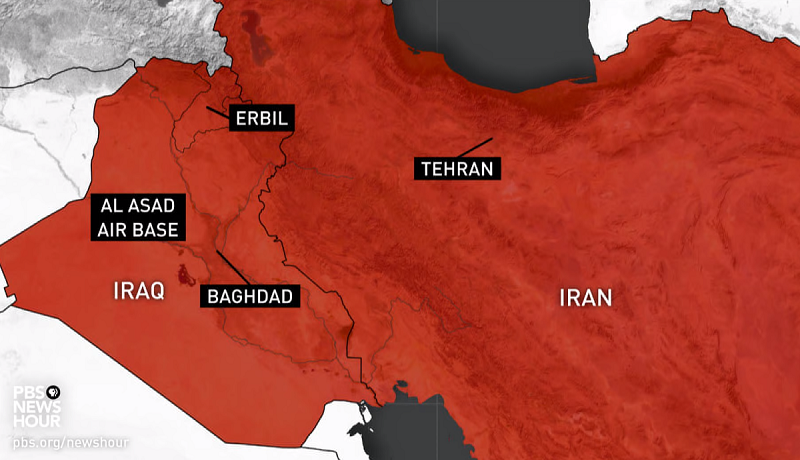
Early Wednesday, Iran’s Revolutionary Guard launched 15 missiles at air bases in Iraq that house American and other international troops.
Iranian state TV reported that the strikes were in retaliation for last week’s killing of General Qassem Soleimani, a top Iranian general. There were no immediate reports of casualties, according to two Iraqi officials.
Soleimani’s killing and the strikes by Iran follow an increase in tensions across the Middle East in the last few years after President Donald Trump’s decided to unilaterally withdraw the U.S. from Tehran’s nuclear deal with world powers. The deal was intended to avoid Iran building a nuclear weapons program.
Iran’s foreign minister said a ballistic missile attack was a “proportionate measures in self-defense” and said it did not wish to escalate the situation but rather defend itself against any aggression.
‘All is well!’ President Donald Trump tweeted shortly after the missile attacks, adding, ‘So far, so good’ regarding casualties.
Ain al-Asad air base houses about 1,500 U.S. and coalition forces, including 70 Norwegian troops.
Read Groups demand answers after Iranians say they were detained on U.S.-Canada border. Watch this Associated Press video, if time allows.
This article was originally published by PBS NewsHour Extra and can be found here.