


Mueller report divides public opinion
Essential question: Why has the Mueller report further divided political leaders and the public?
Share
May 30, 2019
Essential question: Why has the Mueller report further divided political leaders and the public?
Share
Mueller Update (May 30, 2019):
Take a look at the three videos below and answer the questions below to find out the latest on Special Counsel Robert Mueller’s investigation into Russia’s interference in the 2016 presidential election. Mueller made his first public appearance on Wednesday since his appointment two years ago.
1. Essential question: What main points did Robert Mueller make in his public statement?
2. How do you interpret his points? Why does Mueller not come out directly to say what should be done as a result of the report?
3. Do you think Mueller’s statement makes it clear as to whether or not Trump obstructed justice? Why is it unconstitutional for the Department of Justice to indict a sitting president? According to Mueller, whose job in the government is it to act if the president commits a crime? (answer: Congress)
4. How do you think Mueller’s statement will affect public opinion about the Trump administration? How about the 2020 presidential election?
5. How does Mueller’s statement on Wednesday differ from Attorney General William Barr’s reaction to the Mueller’s report? (see below to learn more about Barr’s four-page summary of the Mueller report)
In a nine-minute statement, he reiterated that Justice Department policy prohibits charging a sitting president with a crime, and that his report did not clear President Trump of committing a crime.
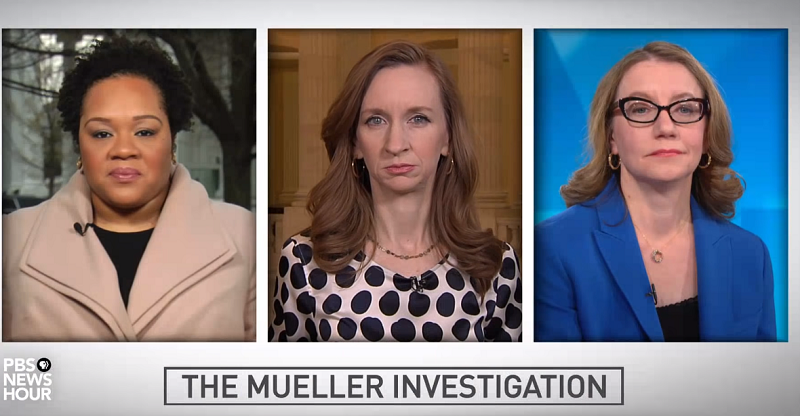
Special counsel Robert Mueller made it clear in his statement on Wednesday that he wants his team’s lengthy report to speak for itself. NPR’s Carrie Johnson and former Justice Department official John Carlin join the NewsHour to revisit key sections of the report and discuss Mueller’s approach to his first public appearance since his appointment two years ago.
Judy Woodruff talks to Chris Buskirk of American Greatness and Kent State University’s Connie Schultz about Robert Mueller’s first public statement in two years and whether it will increase momentum for impeachment, policy plans among 2020 Democratic presidential candidates and the top issues on voters’ minds.
Original Post (3/27):
Summary: Attorney General William Barr’s summary of the Mueller report says there is insufficient evidence that President Donald Trump or his campaign colluded with Russia during the 2016 election. In response, the White House claimed victory, while Democrats insist the full report be made public. As of Tuesday, the only document that has been released to the public is Barr’s four-page synthesis of Mueller’s report. Trump sent out a list of Democrats who claimed there was evidence that he colluded with Russia, insisting they be held accountable. Meanwhile, Democrats point out that although Trump wasn’t charged with obstruction, he also wasn’t exonerated. To learn more what American voters think about the Mueller report, read this articleby the Associated Press.
Directions: Read the summary, watch the videos and answer the discussion questions below. You may want to turn on the “CC” (closed-captions) function and read along with the transcript here. If time is of the essence, you might want to stop the segment at 3m:33s.
Mueller Report Discussion questions
1) Essential question: Why has the Mueller report further divided political leaders and the public?
2) What do you know about the Mueller investigation? What prompted the investigation? What did the investigation have to do with Russian meddling in the 2016 election?
3) Why was Special Counsel Robert Mueller’s full report not released? Do you think the full report should be released to the public? Explain your response.
4) According to Barr’s synopsis, the Mueller report stated that Russia interfered with the 2016 presidential election by attacking Trump’s opponents on social media and stealing emails from Hillary Clinton’s campaign and the Democratic National Committee, however, the Trump campaign did not coordinate these actions. Why is this distinction be important?
Dig deeper: Have students dig deeper into the U.S. democratic system as it relates to the Mueller investigation, Russia’s interference in the 2016 election and President Trump’s financial ties to Russia.
1. The nearly two-year investigation of special counsel Robert Mueller into Russian interference in the 2016 presidential election concluded with Mueller’s final report delivered to Attorney General William Barr for review. PBS NewsHour and FRONTLINE illuminates the complex details behind the Mueller investigation and analyzes what’s yet to come. You may wish to watch parts of the documentary below in class or assign parts of it to your students for homework.
2. Republicans say the attorney general’s four-page summary of the Mueller report exonerates President Trump on obstruction of justice. Democrats counter that William Barr’s analysis is not sufficient to answer that question. Judy Woodruff talks to Neal Katyal, former acting solicitor general under President Obama, and Paul McNulty, former deputy attorney general under the first President Bush. See the transcript here.
3. In November, PBS NewsHour’s Lisa Desjardins spoke with David Sanger, national security correspondent for the New York Times, and Matea Gold, enterprise and investigations editor for the Washington Post, about potential conflicts between Trump’s business and policy interests. Why do you think Trump’s financial interests with Russia were not a focus of the Mueller report? (remember: the Mueller report focused on collusion between the Trump campaign and Russia during the 2016 presidential election.) See the transcript here.
4. There is no doubt that Russia’s government attempted to influence the 2016 U.S. presidential election. As William Brangham reports, once the U.S. intelligence community reached that consensus, as well as high confidence that Russian President Vladimir Putin personally ordered the cyber and social media “disinformation” campaigns, a major investigation and dozens of indictments followed. See the transcript here.
Visit PBS NewsHour Extra for more education resources designed to help teachers and students identify the who, what, where and why-it-matters of the major national and international news stories. You can read the original story here. @NewsHourExtra