



About This Lesson
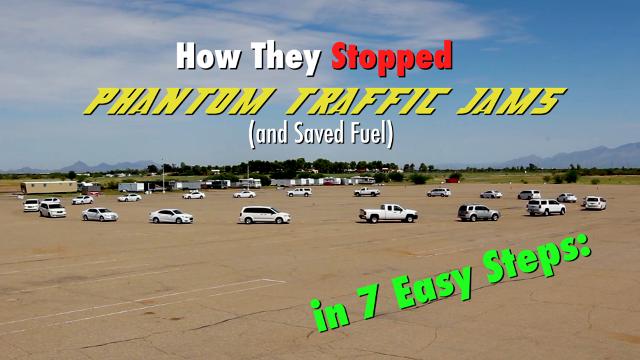
Traffic waves occur when there are too many cars on the road. Now that autonomous vehicles are on the horizon for consumers, a number of research activities have focused on the influence of automated vehicles on traffic flow. A team funded by the National Science Foundation demonstrated that -- if controlled effectively -- driverless cars are able to reduce stop-and-go waves that can arise in normal traffic patterns. The experiments, conducted on a circular track with more than 20 vehicles, show that traffic waves emerge consistently, and that they can be reduced by controlling the speed of a single vehicle in the flow. The team compared metrics for velocity, braking events and fuel economy across experiments. These findings suggest a new way to look at traffic management: Traffic flow control will be possible via a few self-driving cars -- less than 5 percent -- long before a majority of vehicles have autonomous capabilities.
Provided by National Science Foundation