




About This Lesson
Thinkalong.org is a free, evidence-based interactive tool for students to develop media literacy skills by applying the 5 Key Questions of Media Literacy to public media content. Importantly, the tool does not require registration for teachers or students, abides by student privacy laws, and is advised by a board of both youth and educators.
Each module consists of:
-
a compelling and timely question;
-
related current and age-appropriate public media content including audio, video, and text;
-
extension resources for advanced or highly-interested students;
-
student graphic organizers;
-
a simple debate tool;
-
a teacher's guide to the module;
-
and a guide to the 5 Key Questions of Media Literacy.
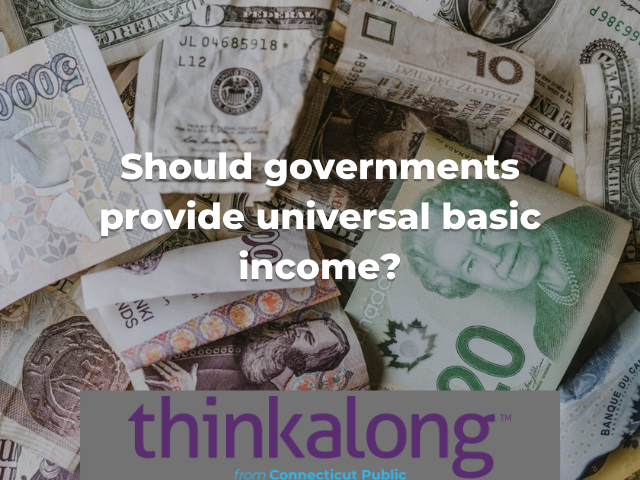
This Teacher's Guide supports the Should governments provide universal basic income? module on thinkalong.org. Here is the full module and below is a summary.
Universal Basic Income (UBI) guarantees that all people receive a regular sum of money to offset the cost of living and meet their basic needs. While small experiments have demonstrated the potential of such programs, some leaders look at global economic stressors, increased work automation, and modern wealth disparities as problems that could be mitigated with UBI. Advocates hope that UBI will lift all Americans above the poverty line and eliminate financial inequality. Opponents worry about the expense, noting that recipients could rely too much on government assistance and neglect their jobs, which would hurt the economy. Others have a concern that universal basic income would result in eliminated or reduced social programs, which assist the poorest populations. Would UBI truly benefit society?
To use this module with learners in any setting, we recommend using one of the structured discussion formats outlined at thinkalong.org/structuring-discussions. You can find options for a small or large group, so that all students or just a few participate, and examples of some discussion formats.