

lesson
11 Downloads
Write a review
beta
EdBrAIn It
EdBrAIn uses AI to customize lesson resources for your students’ needs.

The Spanish-American War's Impact on Cuba and Puerto Rico Featuring Bad Bunny

Share

Share On Facebook
Share On Twitter
Share On Pinterest
Share On LinkedIn
Email

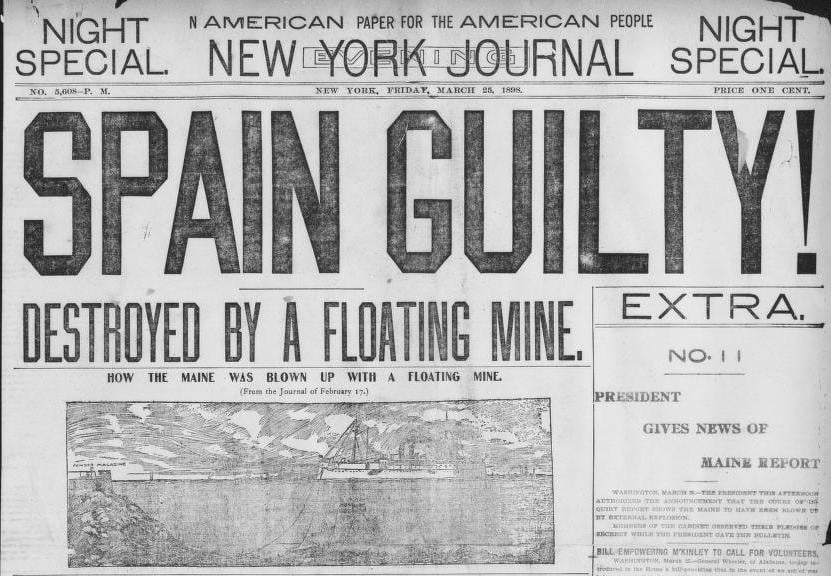
New York evening journal. (New York, NY), Mar. 25 1898. https://www.loc.gov/item/sn86071545/1898-03-25/ed-6/.

Grade Level Grades 9-12
Resource Type Handout, Lesson Plan
Standards Alignment
Civic Life (C3) Framework for State Social Studies Standards, Common Core State Standards, State-specific

About This Lesson

In this lesson, students will participate in a press conference scenario and examine newspaper headlines to identify why the Spanish-American War started. Students will then analyze amendments and Bad Bunny’s “El Apagón” music video to identify the impact of American imperialism after the Spanish-American War. Students will complete the lesson with an activity investigating the reliability of internet sources. 

Resources

Files

beta
EdBrAIn uses AI to customize lesson resources for your students’ needs.

Spanish American War_Printable Lesson.pdf

Lesson Plan
September 30, 2025
423.95 KB
beta
EdBrAIn uses AI to customize lesson resources for your students’ needs.

Gallery Walk - Newspaper Headlines .pdf

Handout
September 30, 2025
23.67 MB
beta
EdBrAIn uses AI to customize lesson resources for your students’ needs.

Handout - (Optional) El Apagon Reading.pdf

Handout
September 30, 2025
77.13 KB
beta
EdBrAIn uses AI to customize lesson resources for your students’ needs.

Handout - Bad Bunny and Puerto Rico in the 21st Century.pdf

Handout
September 30, 2025
167.91 KB
beta
EdBrAIn uses AI to customize lesson resources for your students’ needs.

Handout - Did the US Keep Its Promise (Teacher's Guide).pdf

Handout
September 30, 2025
108.4 KB
beta
EdBrAIn uses AI to customize lesson resources for your students’ needs.

Handout - Did the US Keep Its Promise.pdf

Handout
September 30, 2025
173.02 KB
beta
EdBrAIn uses AI to customize lesson resources for your students’ needs.

Handout - Investigation - What is a Reliable Source.pdf

Handout
September 30, 2025
176.27 KB
beta
EdBrAIn uses AI to customize lesson resources for your students’ needs.

Handout - Press Conference Packet (President McKinley).pdf

Handout
September 30, 2025
163.18 KB
beta
EdBrAIn uses AI to customize lesson resources for your students’ needs.

Handout - Press Conference Packet (The Press)_V2.pdf

Handout
September 30, 2025
166.42 KB
beta
EdBrAIn uses AI to customize lesson resources for your students’ needs.

Handout - Puerto Rico A US Territory.pdf

Handout
September 30, 2025
86.71 KB
Videos
Bad Bunny - El Apagón - Aquí Vive Gente (Video Oficial) | Un Verano Sin Ti
Remote video URL

Standards

Evaluate how historical events and developments were shaped by unique circumstances of time and place as well as broader historical contexts.
Use questions generated about individuals and groups to assess how the significance of their actions changes over time and is shaped by the historical context.
Integrate evidence from multiple relevant historical sources and interpretations into a reasoned argument about the past.
Analyze multiple and complex causes and effects of events in the past.
Analyze complex and interacting factors that influenced the perspectives of people during different historical eras.
Distinguish between long-term causes and triggering events in developing a historical argument.
Describe the Spanish-American War and U.S. expansion in the South Pacific.
Analyze the history, culture and government structure of at least two countries prior to American intervention (e.g., Hawaii, the Philippines, Puerto Rico).
Analyze the domestic debates and decisions regarding foreign intervention and the United States’ emergence as an imperial power (e.g., the Spanish-American War, Philippine-American War, intervention in Latin America, the annexation of Hawaii).
Analyze reasons for and efforts of different nations to maintain or regain economic and political freedoms following American intervention using primary sources from the perspective of native communities (e.g., Hawaiians, Filipinos).
Assess the modern political, social and economic impacts of American imperialism on different territories and governments (e.g., the Philippines, Marshall Islands, Puerto Rico, Guam, American Samoa).
the Spanish-American War (1898) and resulting changes in sovereignty for Cuba, Guam, Puerto Rico and the Philippines; the Philippine-American War (1899–1902)
The Platt Amendment describing the role of the United States in Cuba (1901) and the subsequent occupation of Cuba (1903, 1906–1909)
Evaluate the role of the media in shaping public opinions and debates about America's emergence as an imperial power (e.g., muckrakers, yellow journalism, propaganda).
Analyze how economic and cultural hegemony influenced American perspectives of imperialism at the end of the 19th century (e.g., Cuba, Puerto Rico, Spanish-American War, Annexation of Hawaii and Philippines, dispossession of Latino American lands in the American West).
Determine the role geography played in gaining access to raw materials and finding new global markets to promote trade.
Cite strong and thorough textual evidence to support analysis of what the text says explicitly as well as inferences drawn from the text.
Determine the meaning of words and phrases as they are used in a text, including figurative, connotative, and technical meanings; analyze the cumulative impact of specific word choices on meaning and tone (e.g., how the language of a court opinion differs from that of a newspaper).
Determine an author’s point of view or purpose in a text and analyze how an author uses rhetoric to advance that point of view or purpose.
Cite strong and thorough textual evidence to support analysis of what the text says explicitly as well as inferences drawn from the text, including determining where the text leaves matters uncertain.
Analyze and evaluate the effectiveness of the structure an author uses in his or her exposition or argument, including whether the structure makes points clear, convincing, and engaging.
Integrate and evaluate multiple sources of information presented in different media or formats (e.g., visually, quantitatively) as well as in words in order to address a question or solve a problem.
Write arguments to support claims in an analysis of substantive topics or texts, using valid reasoning and relevant and sufficient evidence.
Write informative/explanatory texts to examine and convey complex ideas, concepts, and information clearly and accurately through the effective selection, organization, and analysis of content.
Produce clear and coherent writing in which the development, organization, and style are appropriate to task, purpose, and audience.
Conduct short as well as more sustained research projects to answer a question (including a self-generated question) or solve a problem; narrow or broaden the inquiry when appropriate; synthesize multiple sources on the subject, demonstrating understanding of the subject under investigation.
Write arguments to support claims in an analysis of substantive topics or texts, using valid reasoning and relevant and sufficient evidence.
Write informative/explanatory texts to examine and convey complex ideas, concepts, and information clearly and accurately through the effective selection, organization, and analysis of content.
Produce clear and coherent writing in which the development, organization, and style are appropriate to task, purpose, and audience.
Gather relevant information from multiple authoritative print and digital sources, using advanced searches effectively; assess the strengths and limitations of each source in terms of the task, purpose, and audience; integrate information into the text selectively to maintain the flow of ideas, avoiding plagiarism and overreliance on any one source and following a standard format for citation.
Draw evidence from literary or informational texts to support analysis, reflection, and research.
Initiate and participate effectively in a range of collaborative discussions (one-on-one, in groups, and teacher-led) with diverse partners on grades 9–10 topics, texts, and issues, building on others’ ideas and expressing their own clearly and persuasively.
Integrate multiple sources of information presented in diverse media or formats (e.g., visually, quantitatively, orally) evaluating the credibility and accuracy of each source.
Present information, findings, and supporting evidence clearly, concisely, and logically such that listeners can follow the line of reasoning and the organization, development, substance, and style are appropriate to purpose, audience, and task.
Initiate and participate effectively in a range of collaborative discussions (one-on-one, in groups, and teacher-led) with diverse partners on grades 11–12 topics, texts, and issues, building on others’ ideas and expressing their own clearly and persuasively.
Integrate multiple sources of information presented in diverse formats and media (e.g., visually, quantitatively, orally) in order to make informed decisions and solve problems, evaluating the credibility and accuracy of each source and noting any discrepancies among the data.
Present information, findings, and supporting evidence, conveying a clear and distinct perspective, such that listeners can follow the line of reasoning, alternative or opposing perspectives are addressed, and the organization, development, substance, and style are appropriate to purpose, audience, and a range of formal and informal tasks.

Reviews

Write A Review

Be the first to submit a review!

Advertisement